
EVALUATING CIRCULAR ECONOMY PERFORMANCE: A Multicriteria Comparative Three-Dimensional Sustainability Assessment of Four SYMSITES EcoSites
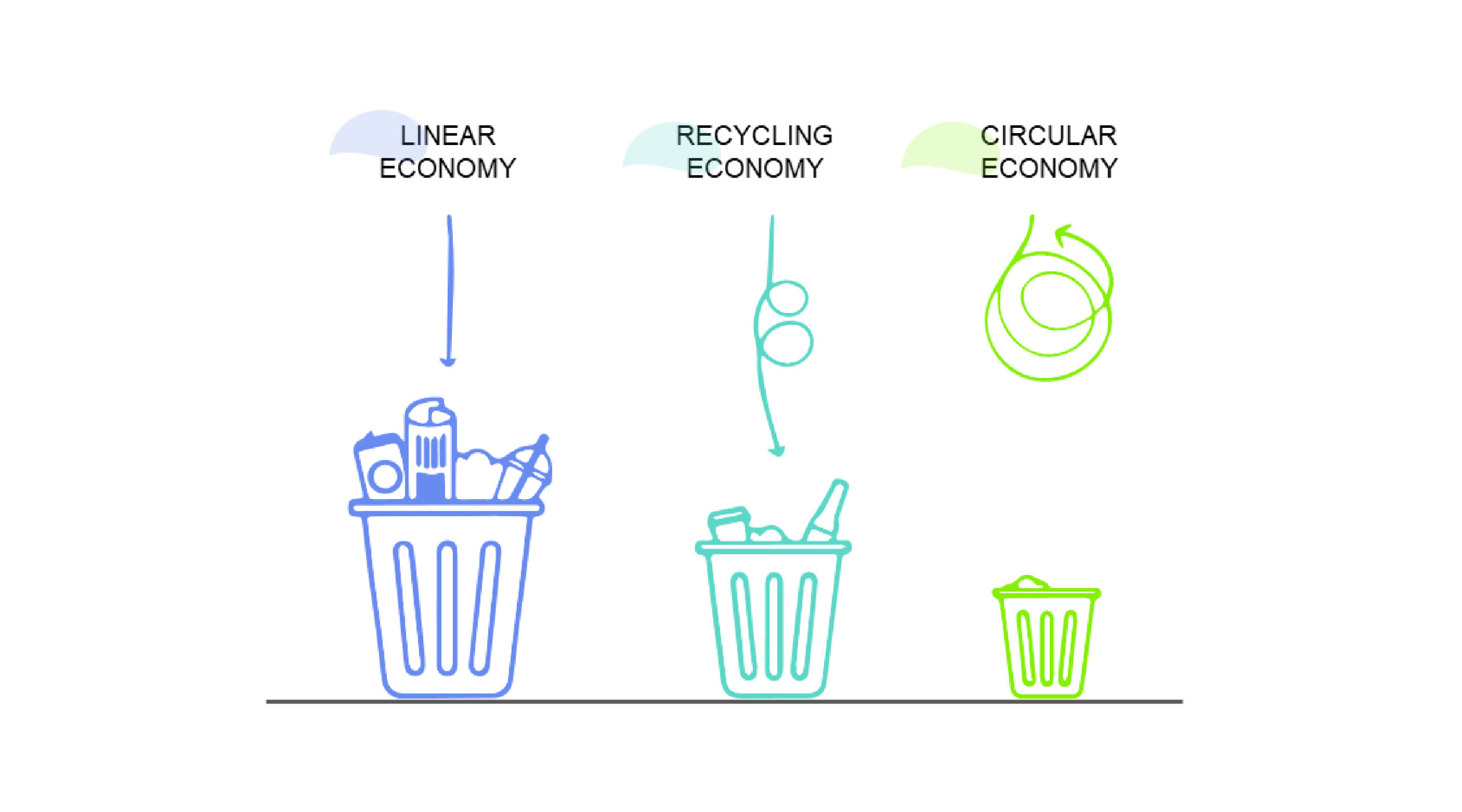
Our current linear economy uses resources once and then discards them, creating waste and pollution. To address climate change and resource scarcity, we need to shift to a circular economy where waste becomes a resource, materials are reused or recycled, and value stays in the community for longer. Industrial-Urban Symbiosis (I-US) is one practical way to make this shift. The SYMSITES project has taken a major step toward this transformation by rethinking how cities and industries manage wastewater, biowaste, and organic residues

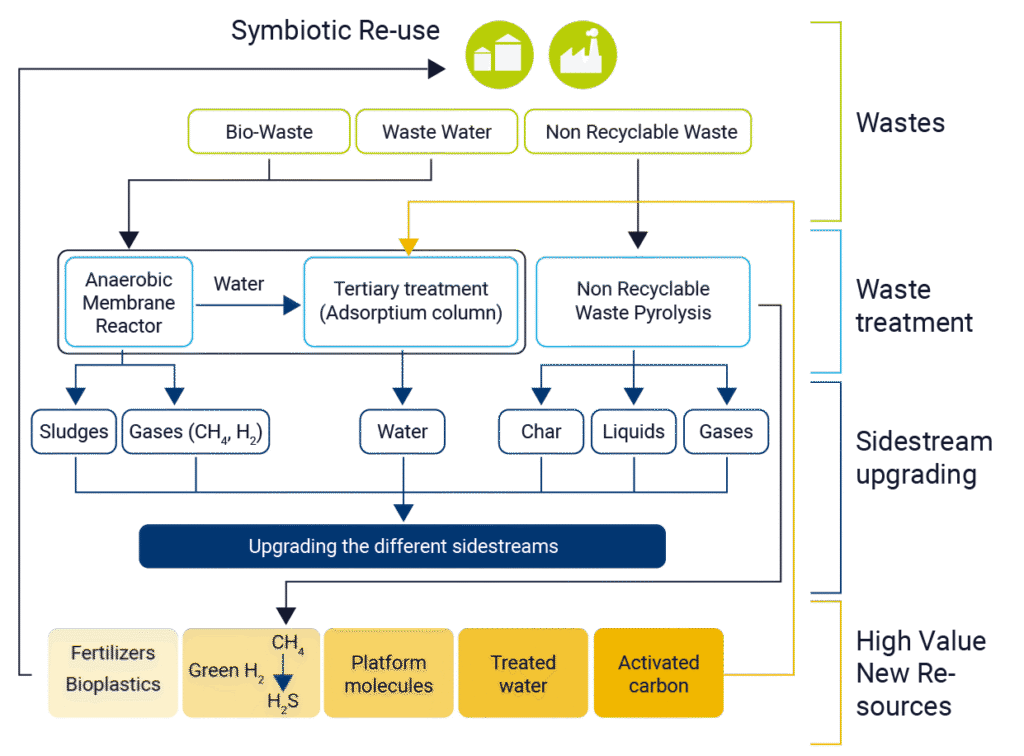
SYMSITES is pioneering a new model for sustainable waste and wastewater management by developing four pilot EcoSites across Greece, Austria, Spain, and Denmark. These EcoSites integrate advanced technologies to treat municipal, industrial, and organic waste streams while recovering high-value resources such as biomethane, hydrogen, treated water, and bio-fertilizers.
Using a comprehensive three-pillar methodology Life Cycle Assessment (LCA), Life Cycle Costing (LCC), and Social Life Cycle Assessment (SLCA) the study evaluated the environmental, economic, and social performance of each EcoSite. Each pilot was also compared to a benchmark representing conventional treatment methods to understand how these new systems perform relative to existing systems.
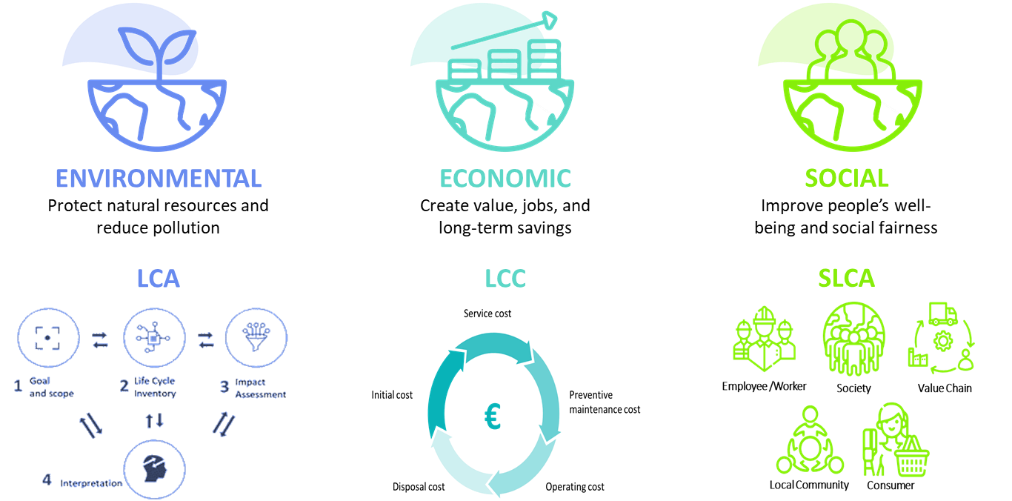
The multicriteria performance assessment compared each EcoSite’s environmental, economic, and social sustainability. Since EcoSites differ in context, direct comparison of absolute results is not meaningful. A benchmark system was therefore created for each Ecosite using the system expansion: each Ecosite was analyzed individually for sustainability performance, and the results were normalized against the ecosystem’s specific benchmark. Both EcoSites and benchmarks were evaluated using the LCA, LCC, and SLCA methods based on a common functional unit, defined by the quantity of waste and wastewater treated and the resources recovered. Benchmarks are simply conventional waste and wastewater treatment plants, as well as standard processes that produce the same high-value resources as outputs. The scores for each sustainability dimension were then aggregated into a single final score associated with each Ecosite.
Overall, the benchmarks currently outperform the EcoSites in absolute terms (which indicates greater sustainability performance of the benchmark), largely due to their industrial scale.
The analysis results show that the closer the score obtained is to 1, the better the EcoSite’s performance, all the more closer to the sustainability performance of the reference benchmark.
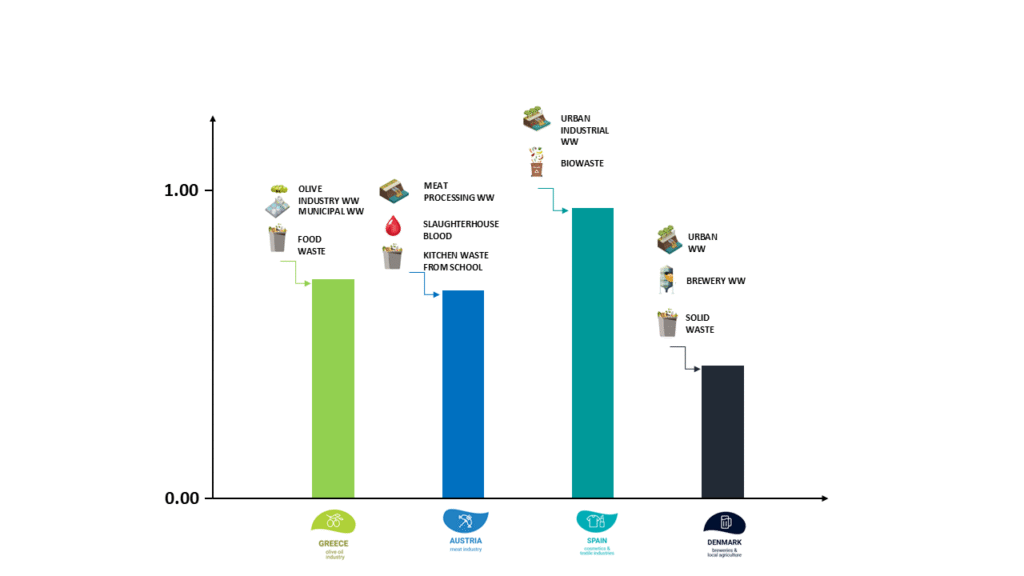
The Spanish EcoSite demonstrated the best overall performance, driven by strong economic and social results, while the Greek EcoSite showed the most favourable environmental performance.
However, further improvements are expected as pilot systems expand and additional waste streams are integrated, allowing for the implementation of truly sustainable competitive technologies.