
Harnessing the Antimicrobial Potential of Baicalein-Coated Fe3O4/Ag Nanoparticles for Biomedical and Environmental Applications – A New Publication by UPC
The Universitat Politècnica de Catalunya (UPC), a partner of the SYMSITES project, has recently published a new scientific article entitled “Harnessing the Antimicrobial Potential of Baicalein-Coated Fe3O4/Ag Nanoparticles for Biomedical and Environmental Applications” in ACS Applied Materials & Interfaces.
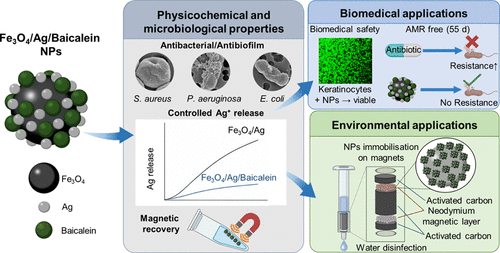
The study addresses one of the most pressing global challenges of our time: antimicrobial resistance (AMR). The increasing ability of microorganisms to withstand conventional antimicrobial treatments poses significant risks for both public health and environmental protection. To tackle this issue, the UPC research team developed an innovative multifunctional nanomaterial combining magnetic iron oxide (Fe3O4), silver nanoparticles, and baicalein, a naturally occurring flavonoid known for its antioxidant and antimicrobial properties.
The resulting nanocomposite demonstrated strong antibacterial activity against several clinically and environmentally relevant pathogens, including Escherichia coli, Staphylococcus aureus, and Pseudomonas aeruginosa. Beyond eliminating bacteria, the material was also effective in preventing biofilm formation and disrupting quorum sensing mechanisms, which play a key role in bacterial communication and resistance development.
One of the most promising findings of the research is the significantly reduced release of silver ions compared to conventional silver-based nanoparticles. This improves the material’s biocompatibility while maintaining its antimicrobial effectiveness. Furthermore, long-term testing showed that the nanocomposite did not promote significant bacterial resistance development, making it a particularly attractive solution for future applications.
As a proof of concept, the researchers incorporated the nanoparticles into activated carbon filtration systems for water treatment. The system achieved complete removal of E. coli from contaminated water while minimizing silver leaching, highlighting its potential for environmental remediation and water purification.
This publication contributes to the development of innovative and sustainable technologies capable of addressing microbial contamination in both biomedical and environmental contexts, supporting SYMSITES’ objective of advancing circular and resource-efficient solutions.
The publication is available here: https://pubs.acs.org/doi/10.1021/acsami.6c02389