
Industrial-Urban Symbiosis in Greece: Addressing Non-Tech Barriers
A workshop held in West Achaia, Greece, within the framework of the EU-funded SYMSITES project, highlighted the critical need to address challenges in awareness, data access, and resource tracking to successfully implement Industrial-Urban Symbiosis (I-US) at scale in the region.
I-US: Reimagining Waste as a Resource
I-US involves the reuse of side streams and “waste” from one process as input into another, creating closed-loop systems that maximize resource efficiency and minimize environmental impact. The SYMSITES project is piloting an innovative approach at the “Ecosite” wastewater treatment plant in West Achaia. Here, olive wastewater, a significant waste stream from the local olive oil industry, is co-treated with municipal wastewater and organic waste. This process yields valuable outputs such as biofuels (biogas and biohydrogen), compost, and water for irrigation.
Local Stakeholders Discuss Barriers to I-US Upscaling
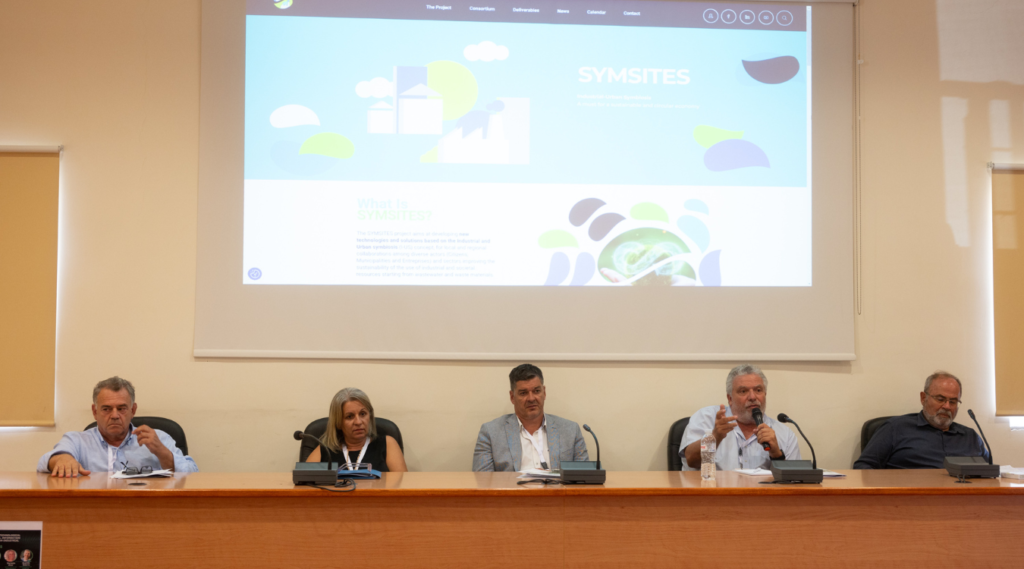
The workshop brought together local authorities and industry representatives to discuss the challenges of scaling up I-US in West Achaia. Participants shared their perspectives and identified key barriers, including:
- Lack of Awareness: Insufficient understanding of the potential benefits and value of waste outputs among local stakeholders.
- Data Gaps: Limited access to and management of data related to waste generation, resource flows, and existing symbiotic exchanges.
- Unrecorded Resource Exchanges: Current waste management tracking systems do not adequately capture existing I-US activities, hindering analysis and optimization.
Expert Insights and Perspectives
The workshop featured a panel discussion with Mr. Angelos Karatzas (Deputy Mayor of West Achaia), Mr. Stathis C. Sideris (Chamber of Commerce of Achaia), and Dr. Zisi Ourania (Directorate of Environment and Spatial Planning of Western Greece). Mr. Karatzas emphasized the need for effective governance to enable multi-stakeholder collaboration and highlighted the importance of skills training for implementing I-US operations.
Industry representatives, including Mr. Dimitrios Livadaros (Panhellenic Business Association of Industrial Areas of Patras) and Mr. George Syriopoulos (General Director of Sirmet S.A.), shared their experiences and perspectives. They noted that while some symbiotic exchanges already occur, these resource efficiencies often go unrecorded, limiting the ability to track progress and identify further opportunities.
Moving Forward: An Action Plan for I-US Implementation
Based on the workshop discussions, the National Technical University of Athens, Sirmet S.A., and the Municipality of West Achaia will collaborate to develop an action plan to address the identified barriers. This plan, expected to be available to the public in late 2025, will provide a roadmap for promoting I-US in the region, including strategies for raising awareness, improving data management, and fostering collaboration among stakeholders.
The SYMSITES project is playing a vital role in advancing I-US in West Achaia by facilitating dialogue, sharing knowledge, and supporting the development of practical solutions. By addressing the challenges of awareness and data management, the project is paving the way for a more sustainable and resource-efficient future for the region.