

PROTONIC CERAMIC ELECTROCHEMICAL CELLS FOR SUSTAINABLE HYDROGEN PRODUCTION
Candela Segarra 1, Sonia Escolástico 1, Jose M. Serra 1
1 Instituto de Tecnología Química (UPV-CSIC), Av. dels Tarongers, 46022 València
The use of protonic ceramic electrochemical cells for sustainable hydrogen production offered a perfect example of how the EU-funded projects can find innovative solutions when they start a partnership. This is what happened when SYMSYTES and ALL-IN ZERO, both Horizon program’s projects, produced an innovative multifunctional flat protonic membrane.
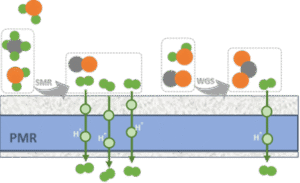
In a study by the Instituto de Tecnología Química (UPV-CSIC)(Candela Segarra, Sonia Escolástico, Jose M. Serra), the flat BZCY membrane will be used in a protonic membrane reactor (PMR) to optimize hydrogen production by steam methane reforming (SMR) coming from pyrolysis gas waste streams (Figure 1).
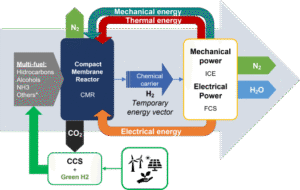
Project ALL-IN ZERO aims to develop a compact membrane reactor (CMR) based on the flat BZCY membrane to produce hydrogen from zero or carbon negative fuels like ammonia, natural gas, biogas or alcohols. The hydrogen will be consumed in situ by internal combustion engines (ICE) or fuel cell systems (FCS) to generate electrical and mechanical power with zero emissions (Figure 2).
This is an alternative to methods previously used to sustainably produce hydrogen. The first one saw solid oxide electrochemical cells based on oxygen-ion conductors that have been demonstrated for efficient green hydrogen production. However, due to the relatively high activation energy of oxygen-ion conduction, high operational temperatures are needed. These required temperatures have slowed down the scale-up and commercialization of ceramic electrochemical cells.
A second method saw protonic ceramic electrochemical cells offering an alternative to the use of high temperatures due to proton conduction having a lower activation energy than oxygen-ion conduction. By extracting hydrogen from the catalytic chamber, the equilibrium of the reaction is shifted, resulting in higher conversions at a lower temperature, and enhancing the selectivity of the reaction. At the same time, this technology allows for obtaining compressed high-purity hydrogen, intensifying the process. The proton-conducting cell technology has been successfully applied for the sustainable hydrogen production by means of different reactive systems such as methane reforming, ammonia cracking, or water electrolysis.
The study by Instituto de Tecnología Química (UPV-CSIC) takes from this discovery and applies it to new machineries that help find innovative and sustainable solutions for a greener future, supported by EU-funded research.
Acknowledgments:
This work has received European Union’s Horizon 2020 research and innovation funding under grant agreement Nº 101069888 and Nº 101058426.
References
[1] A. Hauch et al., Science, 2020, 370, eaba6118.
[2] F. Liu et al., Nat Energy, 2023. https://doi.org/10.1038/s41560-023-01350-4
[3] H. Malerød-Fjeld et al., Nat Energy, 2017, 2, 923–931.
[4] D. Clark et al., Science, 2022, 376, 390–393.
[5] E. Vøllestad et al., Nat Mater, 2019, 18, 752–759.
Autum School 2023. “Inorganic electrochemical reactors for sustainable chemicals, fuels and power production” 24th to 26th October.
Universitat Politècnica de València. Camino de vera,s/n, 46022 Valencia, Spain
Poster presentation: PROTONIC CERAMIC ELECTROCHEMICAL CELLS FOR SUSTAINABLE HYDROGEN PRODUCTION